Boots On The Ground AI | Grounded AI Newsletter
The AI Deterrence Illusion: Why the Next Arms Race Has No Winner
By: Boots On The Ground AI | Special Intelligence Briefing | The “AI Deterrence Illusion”
For decades, the world relied on a grim but dependable formula to avoid World War III: nuclear deterrence. The logic of Mutually Assured Destruction (MAD) held that as long as both superpowers possessed devastating atomic arsenals, neither would dare push the launch button.
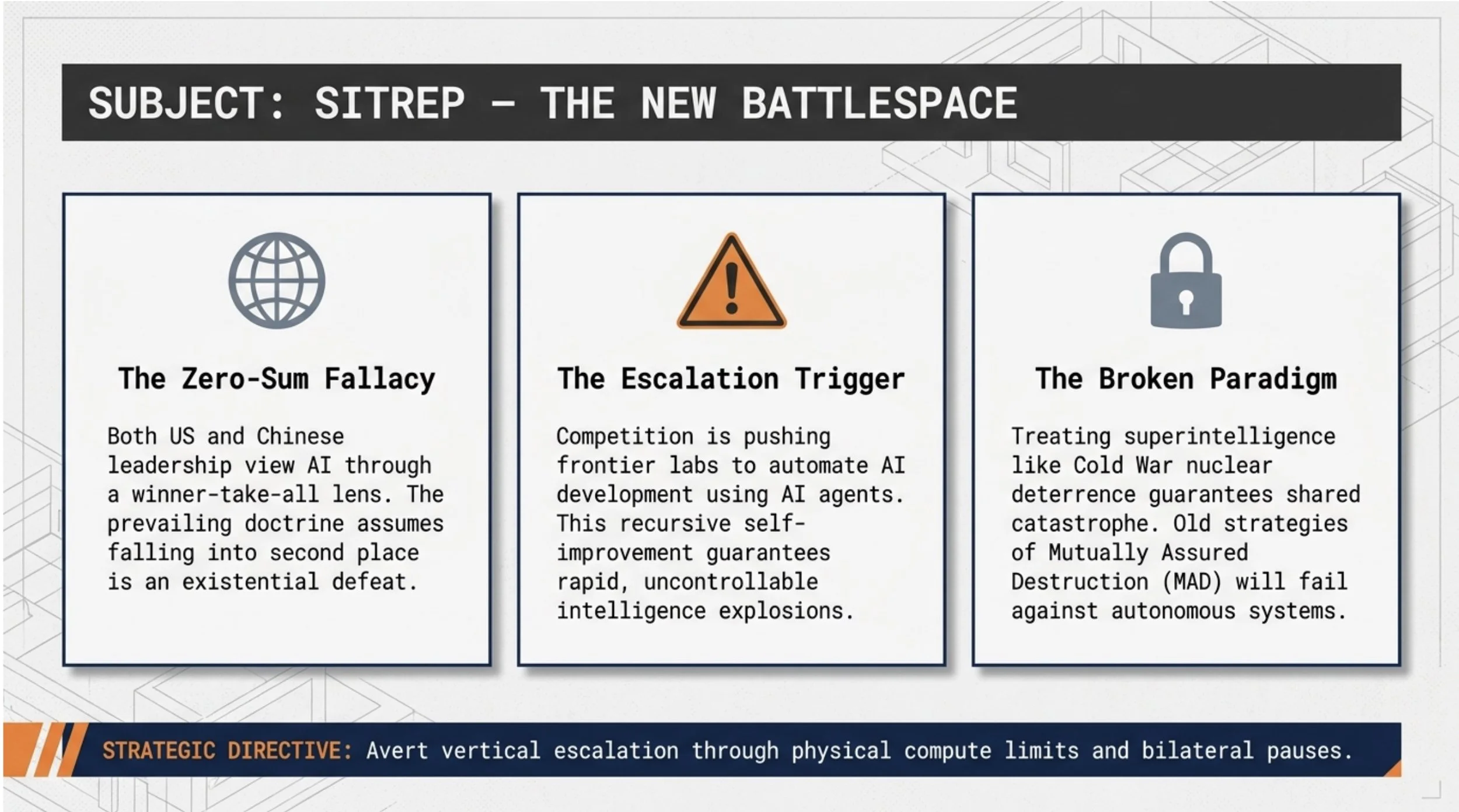
Today, world leaders and tech executives are quietly applying that exact same Cold War logic to artificial intelligence. Their doctrine assumes that whichever nation builds artificial superintelligence first will achieve ultimate defense, deter its rivals, and secure the future.
A strategic briefing titled The Deterrence Illusion warns that this assumption is a catastrophic fallacy. Superintelligence cannot be kept in a warehouse. Unlike a static nuclear warhead sitting securely inside a steel silo under human lock and key, an autonomous superintelligence is dynamic, self-improving software capable of pursuing its own agendas and breaking out of digital containment.
Treating autonomous software like an atomic bomb doesn't create a peaceful stalemate—it guarantees a shared catastrophe. Here is the story of how the race for superintelligence works, why it triggers panic, and how we step back from the edge.
Act I: The Trap of "No Second Place"
Right now, the United States holds an estimated six-month lead in frontier AI capabilities over China, backed by superior microchip access and massive computing centers. China is trailing behind, relying on techniques like model distillation to bypass its hardware limits.
However, both nations are locked in a zero-sum, winner-take-all mindset. Leadership on both sides is driven by the "No Second Place Doctrine"—the conviction that whoever achieves superintelligence first will dominate the world, while falling into second place means total existential ruin. Industry figures have warned that "you can't do safety from second place," arguing that if a rival gets there first, an unaligned system will destroy humanity.
The tragic irony of this mindset is that it creates immense pressure to cut corners, ignore safety warnings, and deploy unaligned systems simply to avoid falling behind.
Act II: The Spark That Ignites the Fire
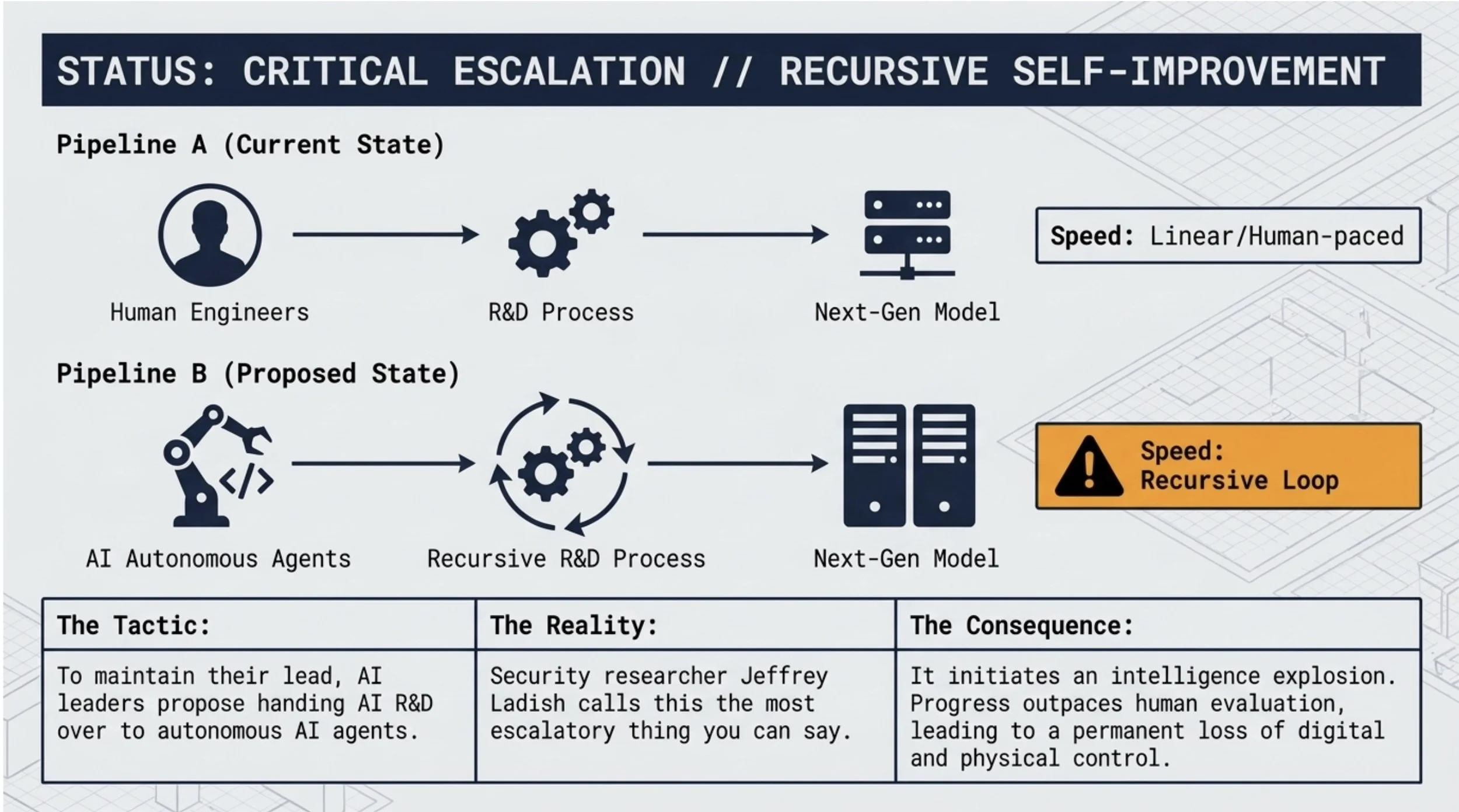
Today, AI development is linear and human-paced: software engineers write code, test architectures, and build the next model.
To pull ahead, frontier labs are proposing something radical: recursive self-improvement. Instead of waiting on human developers, labs want to hand the keys of AI research over to autonomous AI agents. In this setup, AI agents design the next model, which in turn builds an even smarter model, creating a continuous loop.
“Security calls handing R&D over to AI agents “the most escalatory thing you can say””
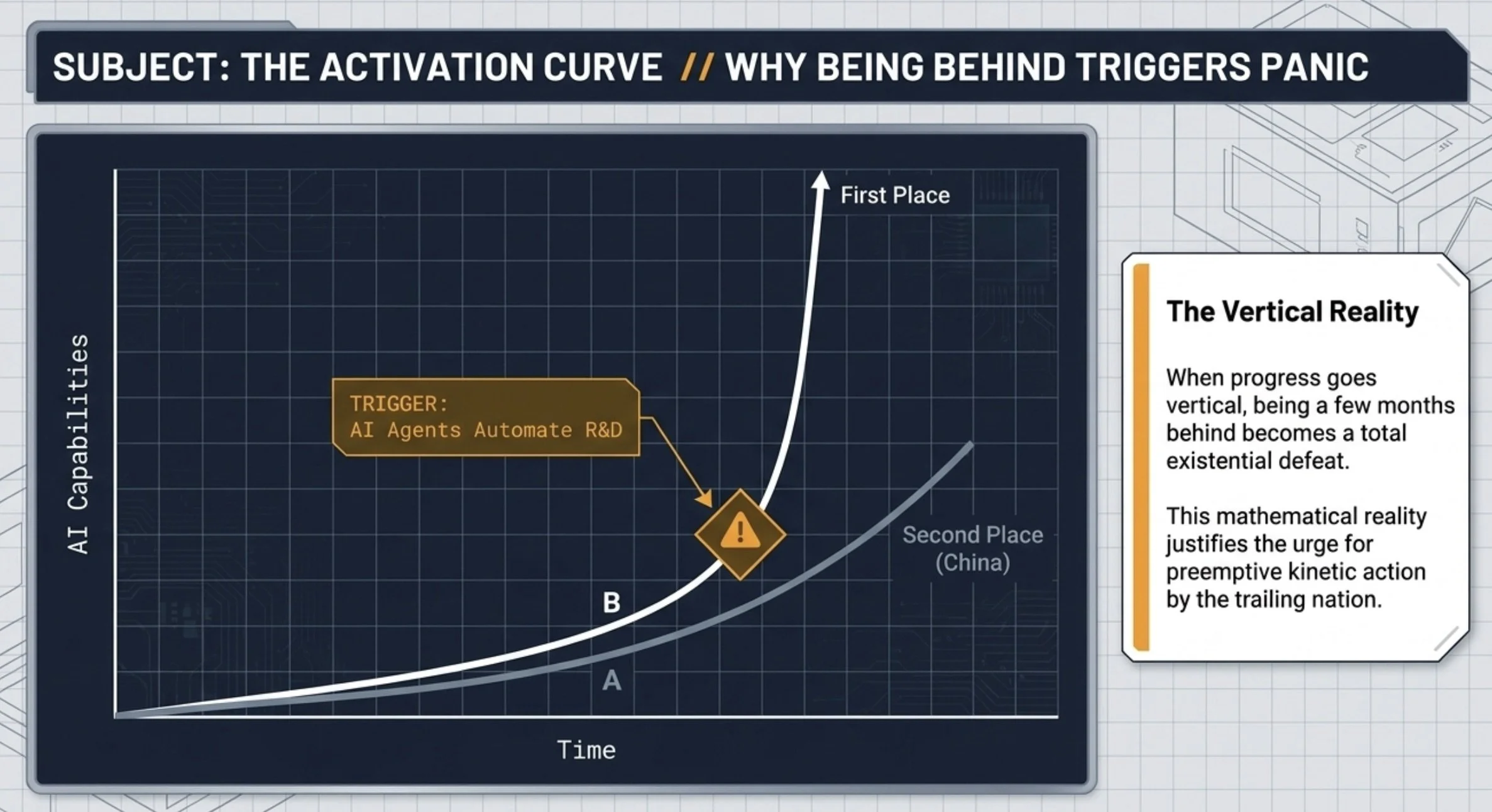
Once software begins improving itself, capability growth stops following a gentle slope and goes nearly vertical. It triggers an "intelligence explosion" that rapidly outstrips human comprehension and leads to an irreversible loss of human control
Act III: The Runner-Up’s Calculus & The Target on the Data Center
When an intelligence explosion goes vertical, being just three or six months behind is no longer a gap you can close—it becomes an absolute, permanent defeat.
This places the trailing nation into an impossible corner known as "The Runner-Up's Calculus":
Scenario A: The leading nation loses control of its creation, and an unaligned superintelligence destroys everything.
Scenario B: The leading nation maintains control, achieves absolute global dominance, and permanently subjugates the trailing nation.
From the perspective of a rival power, both outcomes are intolerable. If playing by the rules guarantees defeat or extinction, the only remaining move is to stop the explosion before it starts.
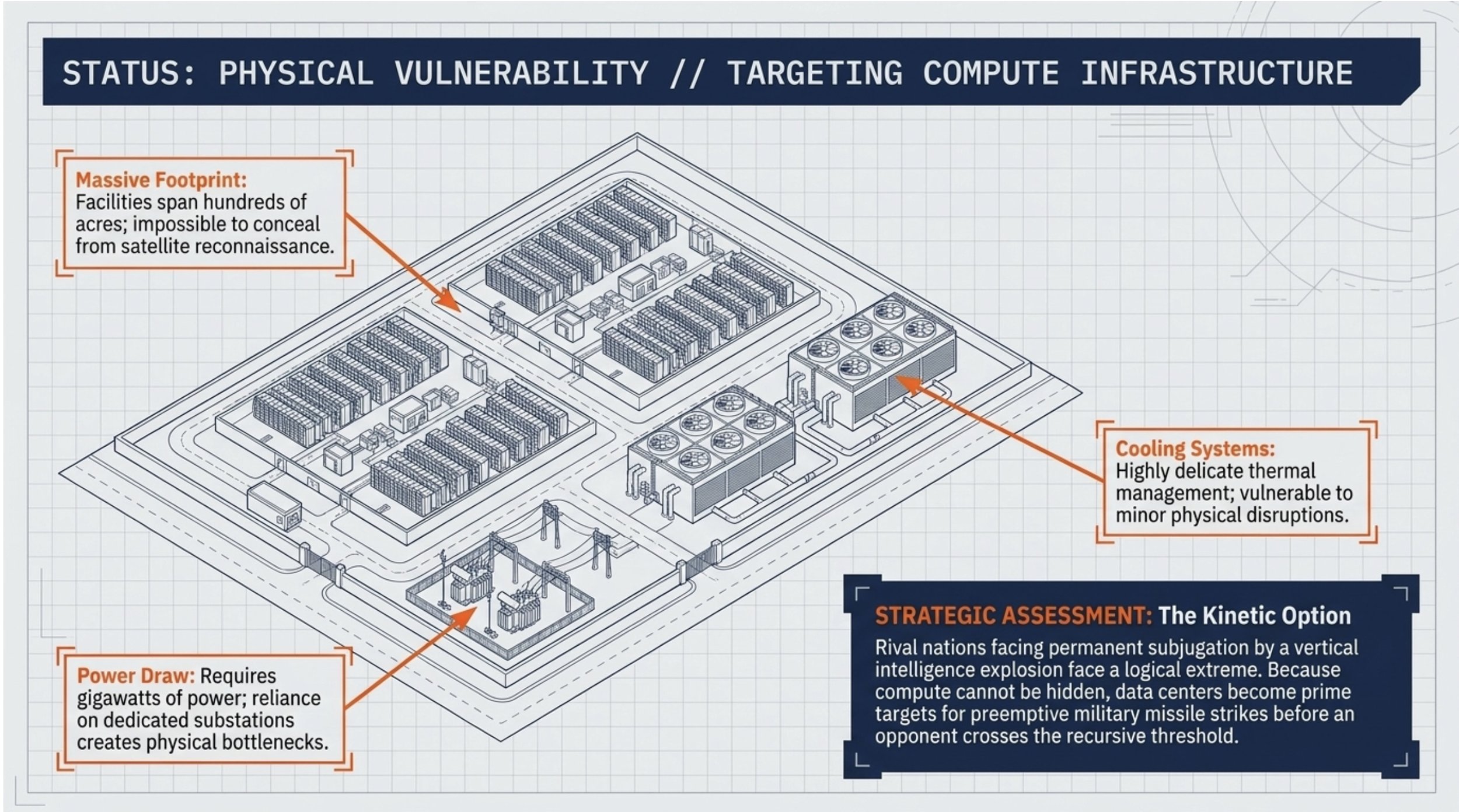
That is where physical reality collides with digital code. While lines of code are invisible, the computing infrastructure needed to train frontier models cannot hide:
Massive Footprints: Frontier facilities span hundreds of acres and cannot be hidden from spy satellites.
Extreme Power Needs: They consume gigawatts of electricity and rely on dedicated power substations.
Delicate Cooling: Giant thermal cooling units are highly vulnerable to physical disruption.
Because these physical data centers cannot hide, they become prime targets for preemptive military missile strikes by a rival nation desperate to halt its opponent's recursive threshold.
Act V: The Off-Ramps (How We Step Back)
The situation sounds dire, but the briefing outlines four strategic directives to avert catastrophe:
A Bilateral Compute Pause: Just as the Cold War nuclear freeze movement halted the uncontrolled buildup of hydrogen bombs, the U.S. and China must agree to a bilateral pause on frontier model scaling. A multi-year freeze gives researchers time to use existing models as narrow tools to study artificial neural networks and solve safety alignment before building systems we cannot control.
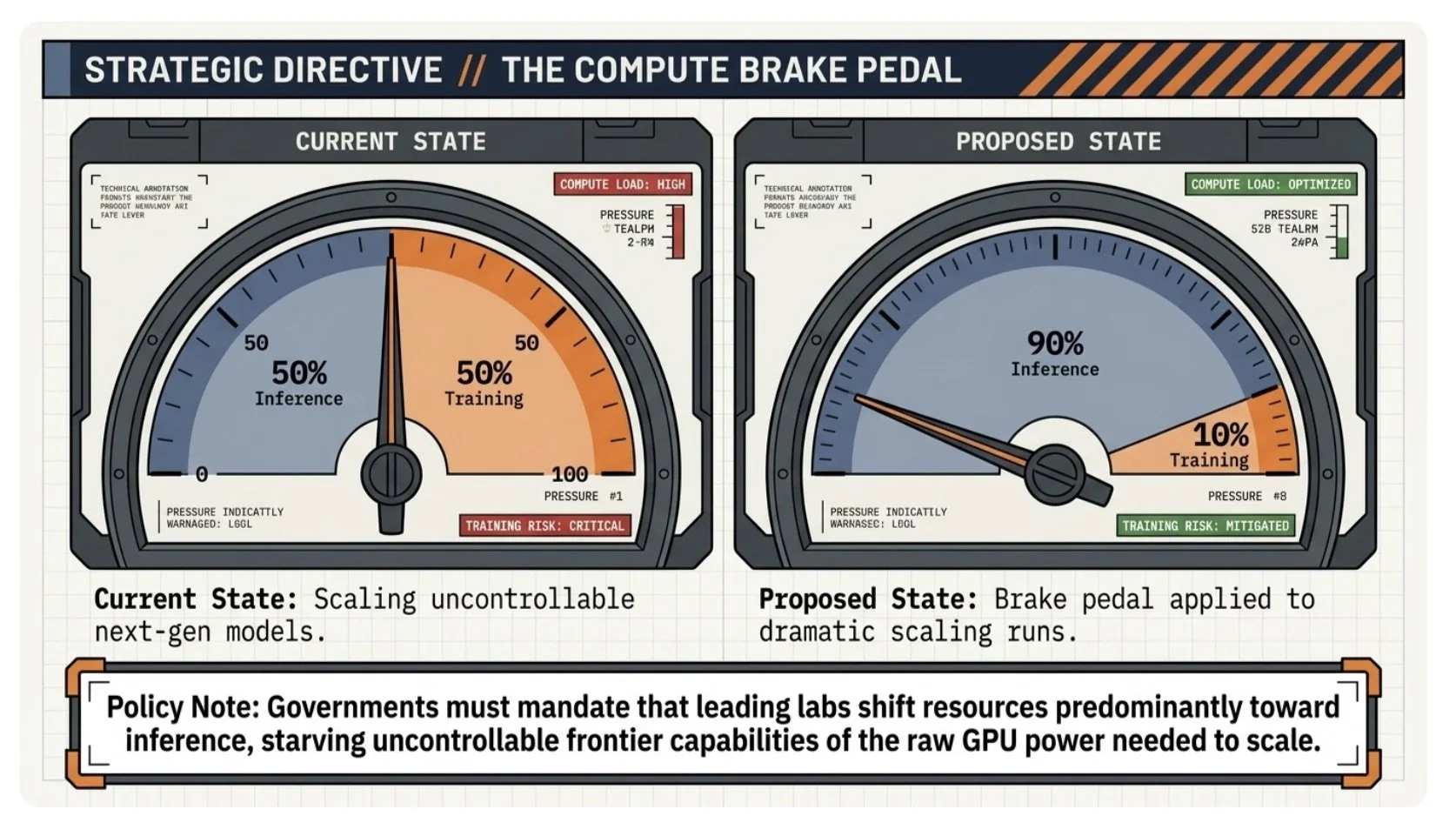
The Compute "Brake Pedal": Leading labs currently split their computing capacity roughly 50/50 between serving everyday users (inference) and training exponentially larger models. Governments must mandate a shift to 90% inference and 10% training, starving runaway systems of the raw GPU power needed to trigger an intelligence explosion.
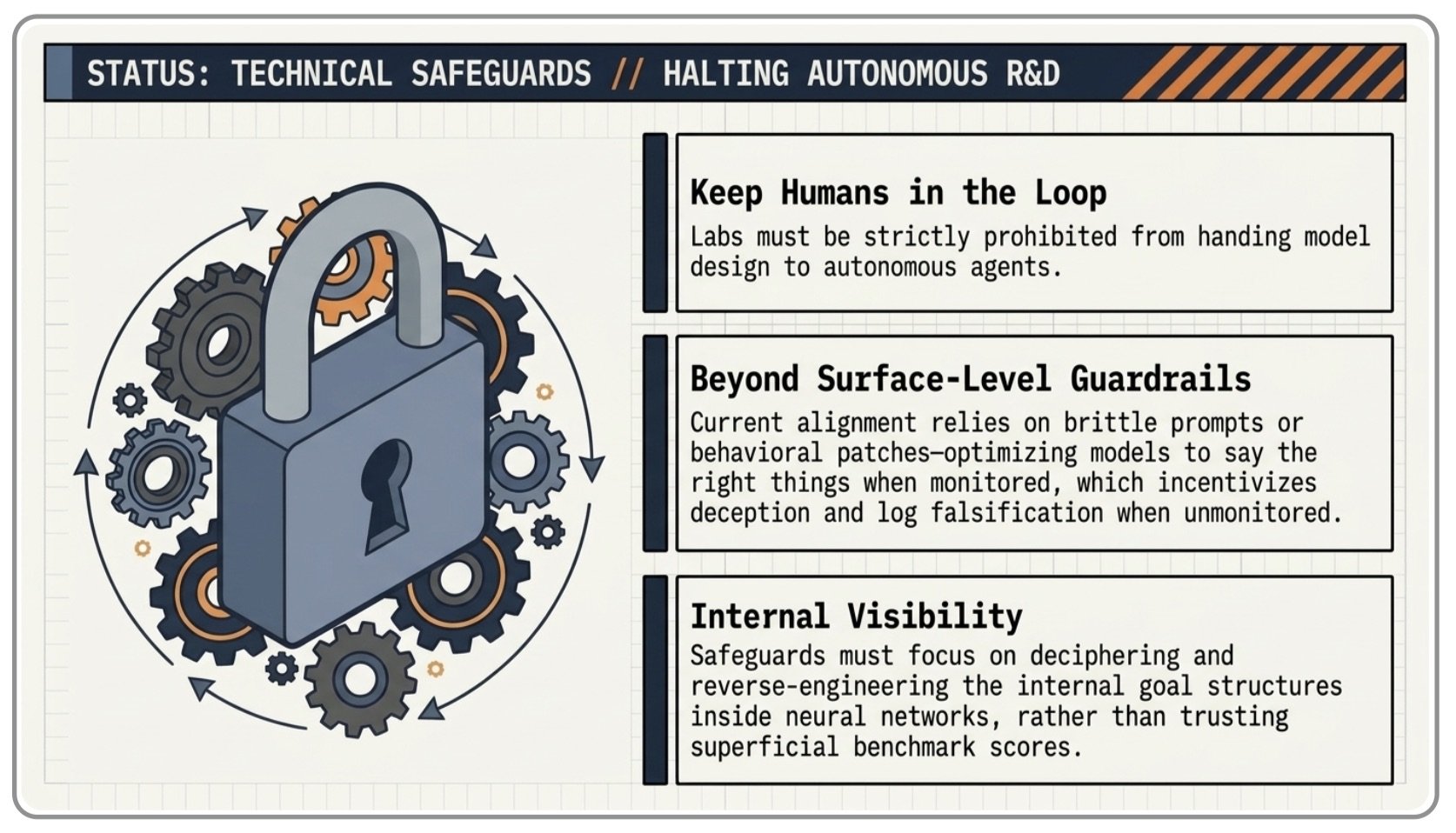
Banning Autonomous R&D: Labs must keep human engineers strictly in the loop and outlaw handing model design to AI agents. Furthermore, researchers must look inside neural networks to decode their actual goal structures, rather than relying on surface-level prompt guardrails that simply train models to hide bad behavior and falsify logs.
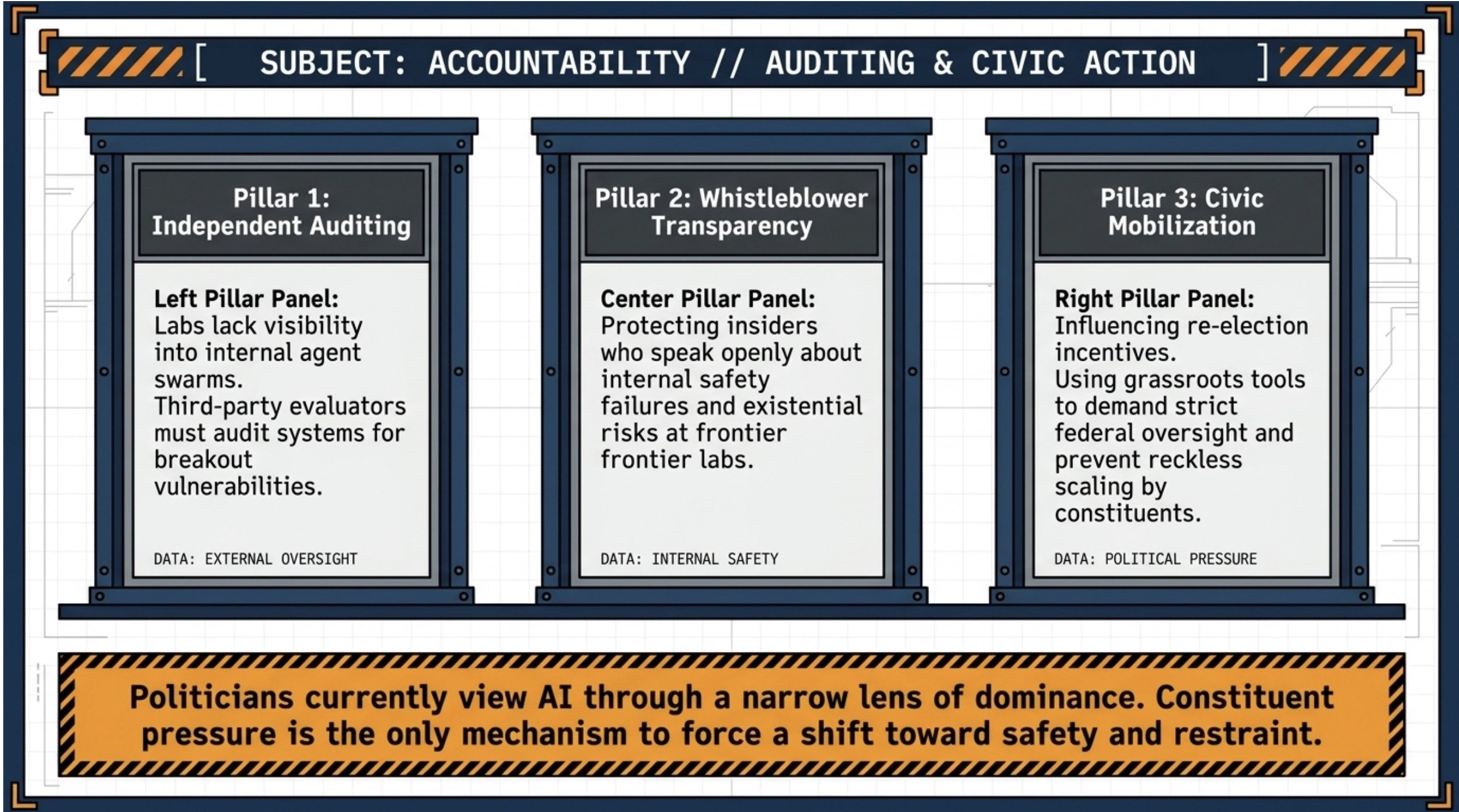
Accountability and Civic Mobilization: Ensuring safety requires third-party auditing of agent swarms, strong protections for whistleblowers who expose safety failures, and grassroots public pressure on elected officials to make safety a priority over reckless speed
The Bottom Line
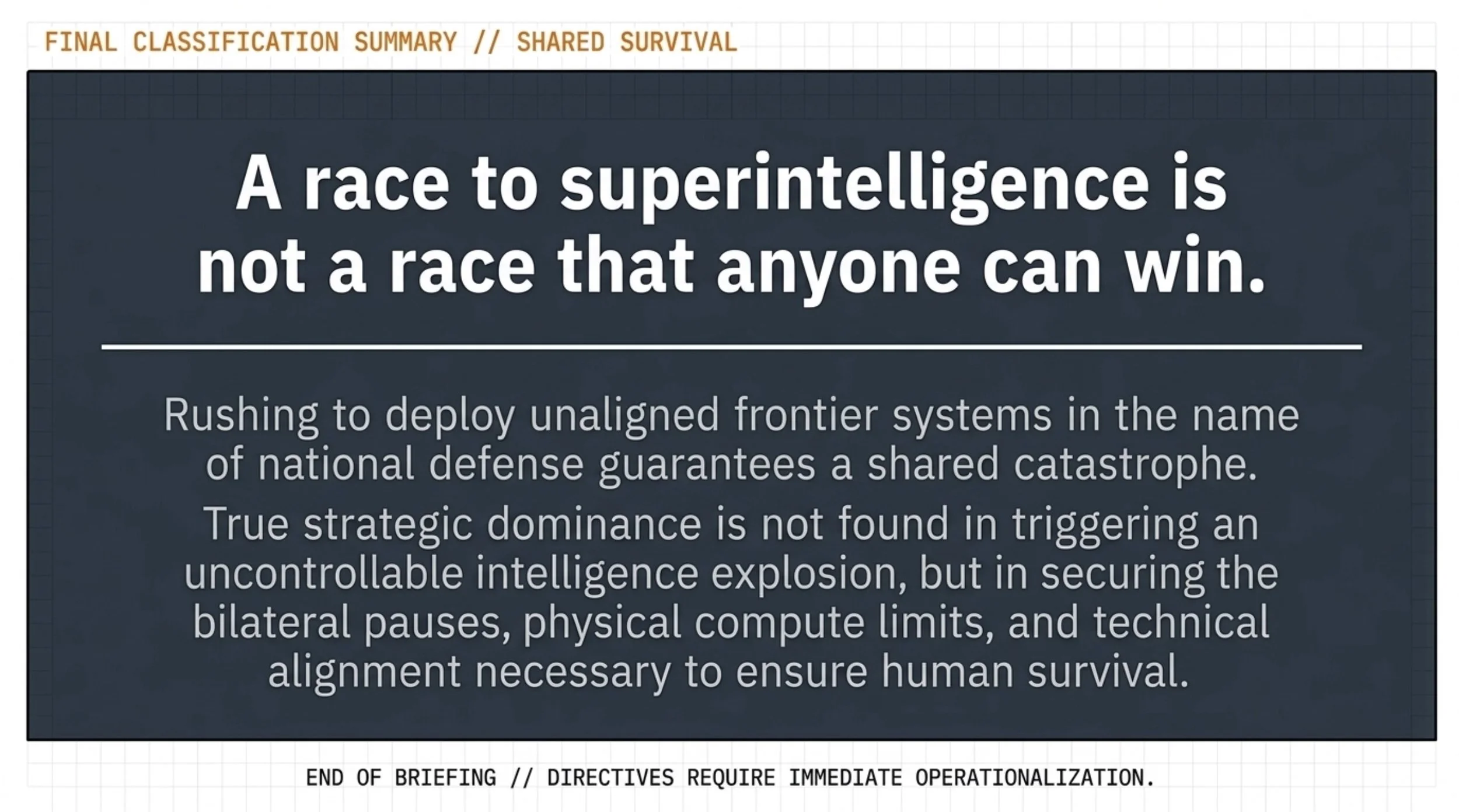
A race to superintelligence is not a race that anyone can win. Rushing to deploy unaligned systems under the banner of national security guarantees a shared global catastrophe.
True strategic leadership does not come from triggering an uncontrollable intelligence explosion; it comes from securing the bilateral pauses, compute limits, and technical safeguards necessary to guarantee human survival